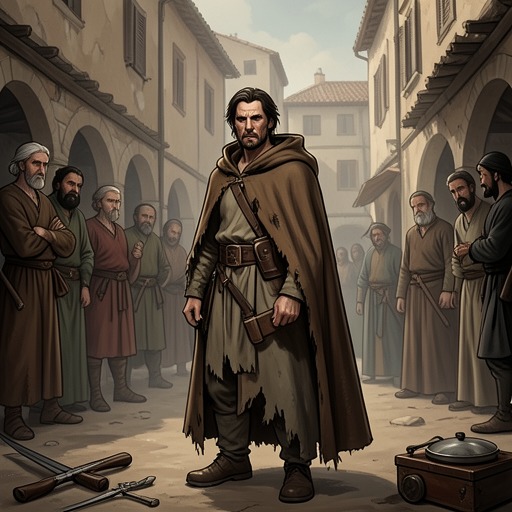
Don Quixote's intervention for Andrés
Don QuixoteDon Quixote’s intervention for Andres becomes a test of whether a dramatic command can actually protect the person it is meant to help. Don Quixote remembers freeing a young servant and securing a promise of wages; Andres’s return reveals that the promise was not kept and that the intervention exposed him to further punishment. The episode turns the knight’s confident account into a dispute over what redressing an injustice requires: not only identifying a wrong and issuing a command, but also remaining to see that the vulnerable person is safe.
The encounter at the spring
While Don Quixote, Sancho Panza, the curate, the barber, Dorothea, and Cardenio pause to eat and drink at a spring, a youth passing by recognizes Don Quixote and embraces his legs in tears. He identifies himself as Andres, the boy Don Quixote had previously released from an oak tree. The sudden reunion brings an earlier adventure into the present company, where its result can be examined by someone other than its would-be rescuer.
Don Quixote welcomes Andres’s recognition as confirmation of his own account. He tells the others that he found the boy tied to an oak and his master striking him, and says that the master had explained the punishment as a response to carelessness. Andres, Don Quixote reports, had instead said that the real dispute concerned unpaid wages. Don Quixote’s narrative presents the difference between those explanations as the reason he intervened: he rejected the master’s justification, ordered Andres released, and required a promise that the boy would be taken along and paid what he was owed.
The intervention and its intended result
In Don Quixote’s retelling, the master submitted to his authority and promised to obey his requirements. Don Quixote emphasizes that he had secured both release and a pledge of payment, and invites Andres to confirm what took place. His purpose in recounting the episode is not merely to remember a rescue; he offers it to the company as evidence that the presence of a knight-errant can correct the abuses committed by powerful or tyrannical people.
That public claim depends on treating the master’s promise as a successful outcome. Don Quixote recalls the command and the apparent submission as the decisive moments, but he had not remained to see whether the wages were paid. The missing follow-through is therefore already present within his own version: the intervention secured a commitment, not proof that Andres received the money or remained beyond his master’s reach. The distinction between an order being given and justice being done becomes the hinge of the episode.
Andres’s account of the aftermath
Andres confirms that Don Quixote’s description of the encounter is accurate, but rejects the conclusion Don Quixote draws from it. After Don Quixote left, the master tied him to the same oak again, punished him further, and mocked the knight for having been made a fool. Andres says that he received none of the wages and spent the intervening time recovering in a hospital. The original rescue, which Don Quixote had treated as an accomplished success, thus emerges as an incomplete intervention followed by retaliation against the person it was meant to protect.
Andres also gives his own account of how the harm escalated. In his view, had Don Quixote continued on his way without getting involved, the master would have given him a limited punishment, then released him and paid what was owed. Instead, Andres says, Don Quixote’s harsh words intensified the master’s anger; because the master could not take revenge on Don Quixote after he had departed, Andres bore the consequences. This is Andres’s explanation of events, not a neutral confirmation of what the master would otherwise have done. Its force lies in the contrast it draws between the knight’s intentions and the risk borne by the person left behind.
Recognition, renewed resolve, and restraint
Faced with Andres’s account, Don Quixote does not deny the failure. He identifies his departure as the mistake and acknowledges that he should have stayed until Andres was paid. He now understands that the master’s promise could not be relied upon once there was no one present to enforce it. His response shows a limited but important recognition: the earlier action failed not because he had failed to command, but because he left before securing the result that mattered to Andres.
Don Quixote immediately proposes to find the master, chastise him, and see Andres paid to the last maravedi. The promise to pursue the matter again restores his habitual confidence, but it also repeats the unresolved question of whether intention and declaration can produce a just outcome. Andres’s terse judgment that the earlier promise had been of no use underscores the distance between Don Quixote’s assurance and the boy’s experience. This time, however, the new undertaking does not begin at once. Dorothea reminds Don Quixote that he has promised not to take up another enterprise until he has completed hers, and asks him to restrain his eagerness until he returns from her kingdom. The episode ends with the proposed redress postponed: Don Quixote has recognized his earlier failure and renewed his pledge, but the evidence here does not establish that Andres is paid or that the master is confronted.